
💻📚 How I Passed the G-Test Through Self-Study | Even a Humanities Major Can Do It [Duration and Materials Revealed]
Updated: Apr 24
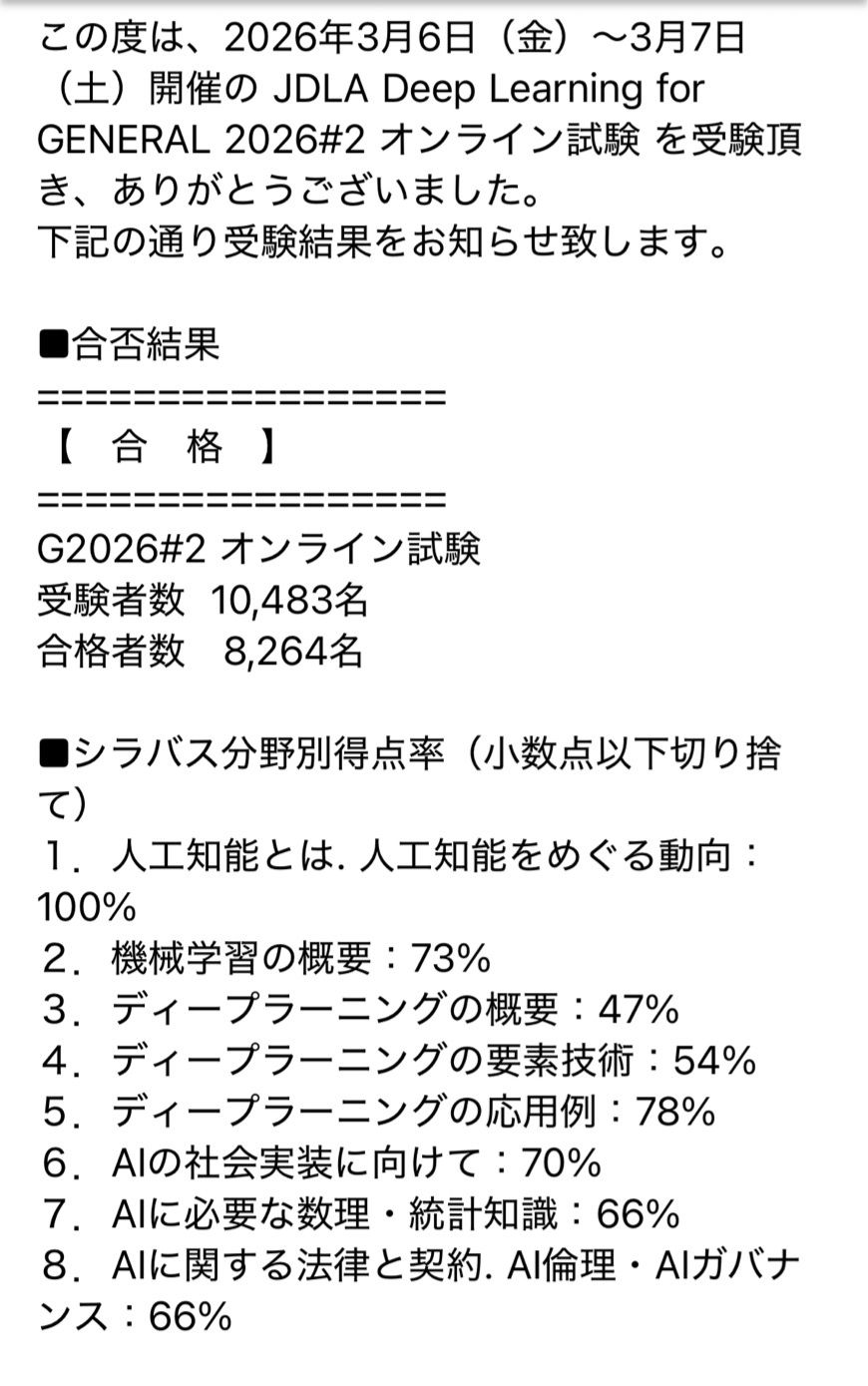
On March 23, 2026, I was so grateful to receive notification from the G-Test administration that I had passed the G-Test! 💮!
Even I, with a liberal arts background and working in a financial institution, was able to pass the G-Test through self-study.
✔ Study period: Approximately 6 months
✔ Materials used: Official textbook + Ultimate textbook + Vocabulary book
✔ Conclusion: The idea that "AI is impossible without mathematical ability" was a misconception.
This article summarizes all the study methods I actually used.
My qualifications are as stated on the "Home" page of this site: I work for a financial institution.
I majored in law in the Faculty of Law at university, a very humanities-focused field.
The G-Test is a very good exam that gives you a glimpse into the world of AI.
I myself read two Python books. They were probably the very basic books that you often see in bookstores. They also had code written in them, so if you copy it down, you can create a "simple" image analysis AI as described in the book (something that will recognize text you write with the mouse, for example).
But... 💦.
I was stuck at the point where I was thinking, "What should I do next to make this useful???" and I got discouraged.
It was like being in a forest of AI and only seeing the trees.
This G-Test shows you the entire forest broken down into several parts.
At first, I couldn't understand what was written in the text.
I was even afraid of the word "algorithm."
But as you keep reading, you start to understand AI a little bit, like, "Wait, is this actually what it means???"
I understood it much better than starting with the two Python books mentioned above.
If you're someone who's actually interested in AI but has given up on it because you think, "I can't understand it without knowing statistics and calculus," then the G-Test can be your entry point into AI.
I highly recommend it!!!
It took me six months to study.
I could only read 10 pages a day of the 480-page textbook (④⑵), and there were times when I wondered if I would really be able to pass.
What I did
Read the official textbook (white book) once (1 week)

👉 G-Test Official Textbook (Must go through it at least once)
Since it's labeled as the official book, I would at least recommend reading it.
Some people might like this book because it's simple, but I felt like "I still don't quite understand it," so I also bought book (2).
The end-of-chapter problems are of very high quality. I solved them many times after finishing book (2).
"G-Test Ultimate Passing Textbook (2nd Edition)" (Green Book)
(Thank you to Professor Yang Jacqueline and Professor Tsutomu Ueno.)

👉 An incredibly easy-to-understand book (my personal top recommendation)
My first impression when I picked it up at the bookstore was, "Wow, it's long and heavy."
But after taking a quick peek (sorry to the bookstore staff!), I thought, "It explains things in a really easy-to-understand way. Maybe I'll be able to understand it better too," so I bought it and started reading it the next day.
My first impression was, "It's easy to understand, but will I still pass...?"
However, as I continued reading, my thinking changed to, "Ah, maybe that's what it means."
The book was filled with diagrams and graphs, which helped lift me up when I was feeling discouraged.
(3) Create your own notes in Excel while reading the text from (2).
The G-Test is an exam that can be taken at home (although you don't actually spend much time looking at it), meaning you can bring in any materials. I read a blog post by someone who said it's important to create your own cheat sheet, and I agree. To be honest, you don't spend much time looking at it during the actual exam, but it was incredibly helpful for organizing my thoughts. I compressed a 480-page textbook into 54 pages. I read this homemade Excel cheat sheet two or three times.

The last month
➡ While reading the cheat sheet on page 54, I thought, "I still feel a bit uneasy." I did about 50% on the practice exam in the green book that I took around this time.
I searched for other things I could do compactly with the remaining time.
That's where I came across the website of Coeteco, which is operated by GMO.
It was "G-Test Preparation Vocabulary Collection: Approximately 600 Words Included."
↓ ↓ ↓

At first, I thought it was just a vocabulary list, and that I didn't really need it.
But if you purchase it for 980 yen, it's not just a simple vocabulary list.
It was an excellent resource that concisely summarized many concepts with an overwhelming number of diagrams and graphs, while also serving as a vocabulary list.
I reread this many times right up until the exam.
At this point, I even started to think, "Hey, maybe I'll actually pass...?" Thank you, Koeteko-sama.
Here, I tried the sample questions provided by the G-Test Secretariat.
There were quite a few instances of people saying, "Huh? What's this word?"
I thought, "This might be a bit dangerous."
Further searching led me to a website called Zero to One (AI Glossary, G-Test Compatible), supervised by Professor Yutaka Matsuo.
This section contains some of the words and explanations that were missing from the sample questions.
"Okay, this is the last one," I thought, and decided to skip the second mock exam. Instead, I frantically memorized the missing vocabulary and its meanings using my smartphone.
And then the day arrived: March 7, 2026.
I had a strange sense of confidence.
Initially, it was partly because it was a company-recommended exam that I started studying for, so it's not like I didn't study at all.
But I think part of it was that I started to think it was really beneficial, and that's when I started to enjoy it.
But nervously, I pressed the "Start Exam" button and, thinking "Now there's no time," I rushed through the 145 questions in 100 minutes. I had about 5 minutes left at the end, but just like the practice exam, it was a race against time and I didn't have time to look at my cheat sheet.
I managed to solve all the questions, and even though I'm not good at "mathematical and statistical knowledge," I was able to solve a few of them, thinking, "Hey, I can do that."
From the next day onwards, I had a feeling that it was all "over," but at the same time, I was worried about what would happen if I failed.
Then, two weeks later, on the morning of March 23rd, my phone rang with a "buzz." I cautiously opened the email, wondering if this was it, and all I could see were the words "[Exam Results]."
Then I let out a sigh and opened the email.
Then the words "■Pass/Fail Result [Pass]" appeared.
To be honest, I was really happy.
Although I was good at Excel VBA programming as a humanities major, reading two Python books completely overturned my preconceived notion that "Ah, in the end, only people with a science background can truly understand AI."
This article
People who have given up on AI, are about to give up on it, or are afraid of it.
People who are thinking of taking the G-Test
I hope this will be helpful to people like that.
Thank you for reading to the end.
■Summary
・Even those with a humanities background can pass.
The key is "understanding → compression → repetition".
• Vocabulary lists are very effective for final review.
I hope this article will be helpful for those who are planning to take the G-Test.
👉 I also share my studies and side business journey on X (feel free to follow me!)
👉 I’ve written other articles as well, so please check them out!


Comments