
Which should I take first, the G-Test or Python? The correct order, as discovered by a humanities student who experienced setbacks.

Which should I start with: the G-Test or Python?
To get straight to the point 👇
👉 For those with a humanities background, "the G-Test should come first."
I myself started with Python but gave up.
But by taking the G-Test first,
👉 I now understand what I need to do.
In this article,
Based on my own experience of failure as a humanities student,
I will explain the correct order.
What is the G-Test? A simple explanation for beginners 👉 It's a qualification for "broadly understanding AI (for generalists)."
That's where I got in.
What does G stand for?
I'm a generalist.
There's the E-certification as a higher-level qualification, right? I'm an engineer.
Why I started with Python (a common pitfall for humanities majors) 👉 Because it seemed useful.
Having already passed the IT Passport exam, the company's recommended exams included the G-Test, the Python 3 Engineer Certification Exam, and the DS (Data Scientist) Certification.
Three choices, huh?
Which one will be useful...? (This was my mistake).
I had some experience developing with Excel VBA, and for me, programming, which I encountered in my 40s, was the first job where I could create something positive, not just eliminate negatives, but turn zero into one.
Hmm.
Given these three options, well,
・G-Test 👉 "It's just a 'general' test about concepts, isn't it?"
・Python 3 Engineer Certification Exam 👉 "Oh, it's a basic test of practical coding skills. After doing some research, it seems that while crawling can be done with VBA, it's more common to do it with Python. I see. This might be good."
・Data Scientist (DS) Certification 👉 "Data science...it sounds like analysis. I don't necessarily need to analyze data with Python; there's also the Odyssey exam, which I'm somewhat proficient in using Excel for statistical analysis (I'm used to taking VBA exams)..."
Yeah!
This is the Python 3 Engineer Certification Exam.
...That's what I thought.
Reasons why I gave up on learning Python (real experience) 👉 I couldn't apply what I learned and I didn't know what to do next.
I browsed a basic Python book at a bookstore on my way home from work (sorry to the bookstore staff! 💦).
I flipped through various books that claimed to be "introductory" or "for beginners."
Yeah, I understand. The basic concept is the same as VBA.
I'll refrain from mentioning the book's title, as some might perceive this as criticism.
Book 1:
Create an app??? Can you really create an app out of nowhere? Well, let's just copy the code and do our best.
Create an AI app??? Are we really going straight to AI? Anyway, let's just copy the code and do our best.
👇
Finished reading.
It's over.
I've created an AI app that can recognize characters written with a mouse...
But have I actually become capable of anything?
I copied the scriptures, but I can't apply them to anything at all.
What should I do?
👉Let's change our mindset and search!! (Generative AI wasn't that widespread back then) "There are search results that say you can build, train, and deploy AI models from scratch on AWS..."
So you also have AWS certifications, I see, that means you can learn systematically as well.
I was browsing books at a bookstore (sorry to the bookstore staff! 💦) 👉 It made no sense. Utter failure.
Now, what should I do?
I decided on the Python 3 Engineer Certification Exam.
Anyway, instead of giving up easily, maybe if you read an even simpler book and put it into practice, you'll grasp something???
Second book: Command Prompt... Hmm. Commands to a PC without a mouse on a black screen. I see. Wow, that feels kind of like being an engineer. Anyway, I'll just copy it down and do my best.
A conversational bot... LINE? Well, it would be nice if I could do that... but it's the same as the first book.
👇
If things continue like this, we won't be able to apply anything to other situations, and we won't know what to do next.
→Feeling of frustration
Why did I return to the G-Test (turning point)? 👉 Is it "easy"? 👉 I had no choice but to do it.
Some time has passed since that feeling of failure. Actually, it's been a year...
I had almost given up on AI.
There's no way I can understand AI.
Only people with a science background who have a solid skill set in statistics and differential and integral calculus can understand this.
👇
Around that time, I heard that someone in my department at work had passed the G-Test.
"The G-Test (of the three recommended exams) seems the easiest," he declared proudly.
Ah, I passed. But even so, I wasn't particularly moved.
Conceptual test... Seems useless. Is it easy?
👇
I've always been the type to intermittently pursue various studies, so I was seriously troubled, thinking, "What should I do now? I can't see my direction."
👇
Some time passed, but the phrase "it was easy" that person had said stuck in my mind.
I guess I'll take a look at the text first. I headed to the bookstore with somewhat heavy steps.
I picked up several books about the G-Test.
"Easy??? SVM? Decision tree? CNN? Transformer? Isn't that just plain difficult???"
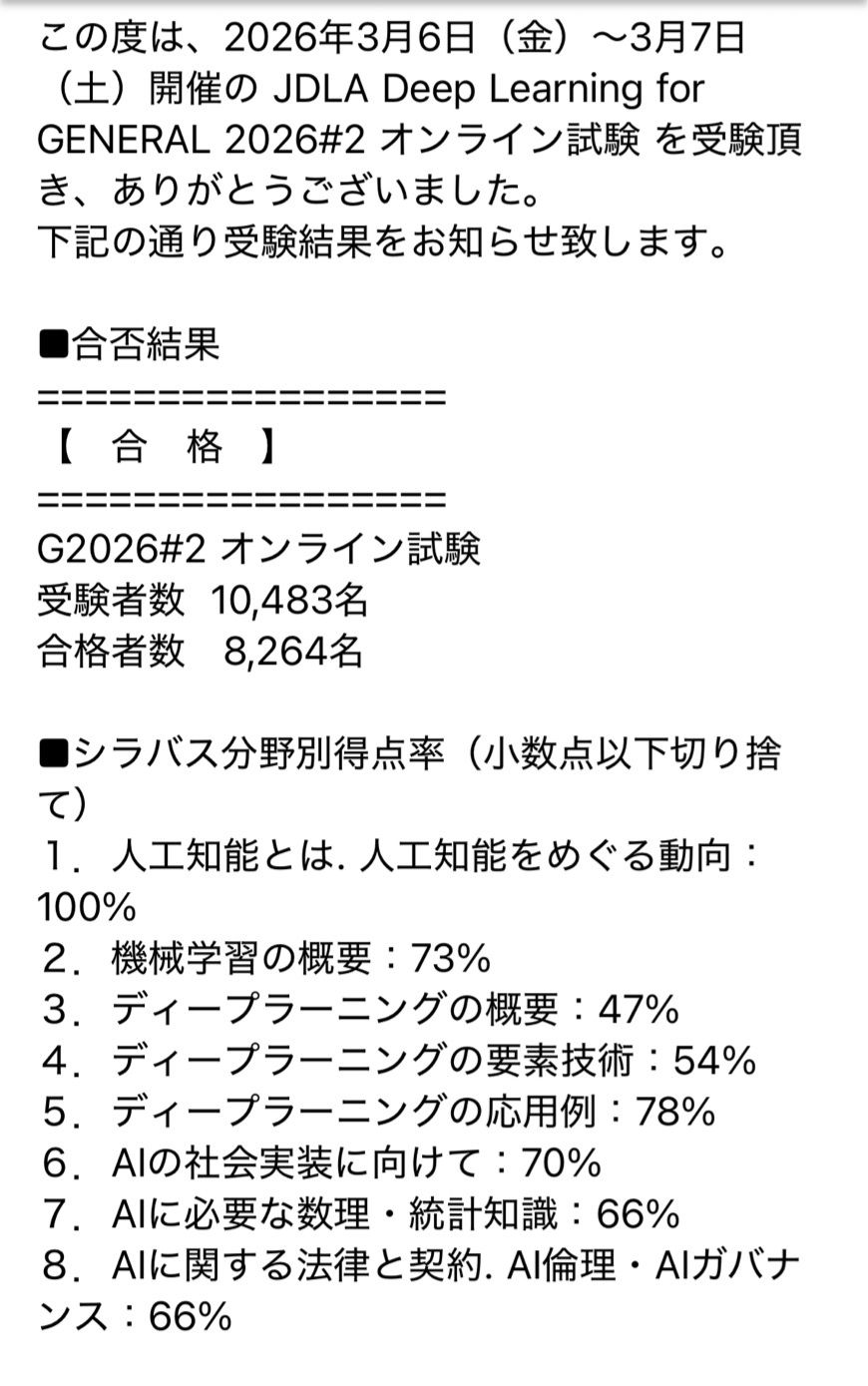
I also looked up the pass rate.
80%?
80% for this level of difficulty?
What kind of people are taking this course?
Oh, but "that person" at the company also passed the exam...
I see. This is the easiest way.
Just try the easiest one first. Just give it your best shot.
I can't see anything else to do. I have no choice but to do it.
That's how my G-Test studies began.
👉 For those with a humanities background, we recommend starting with the G-Test.
Specific study methods are summarized here 👇


Comments